
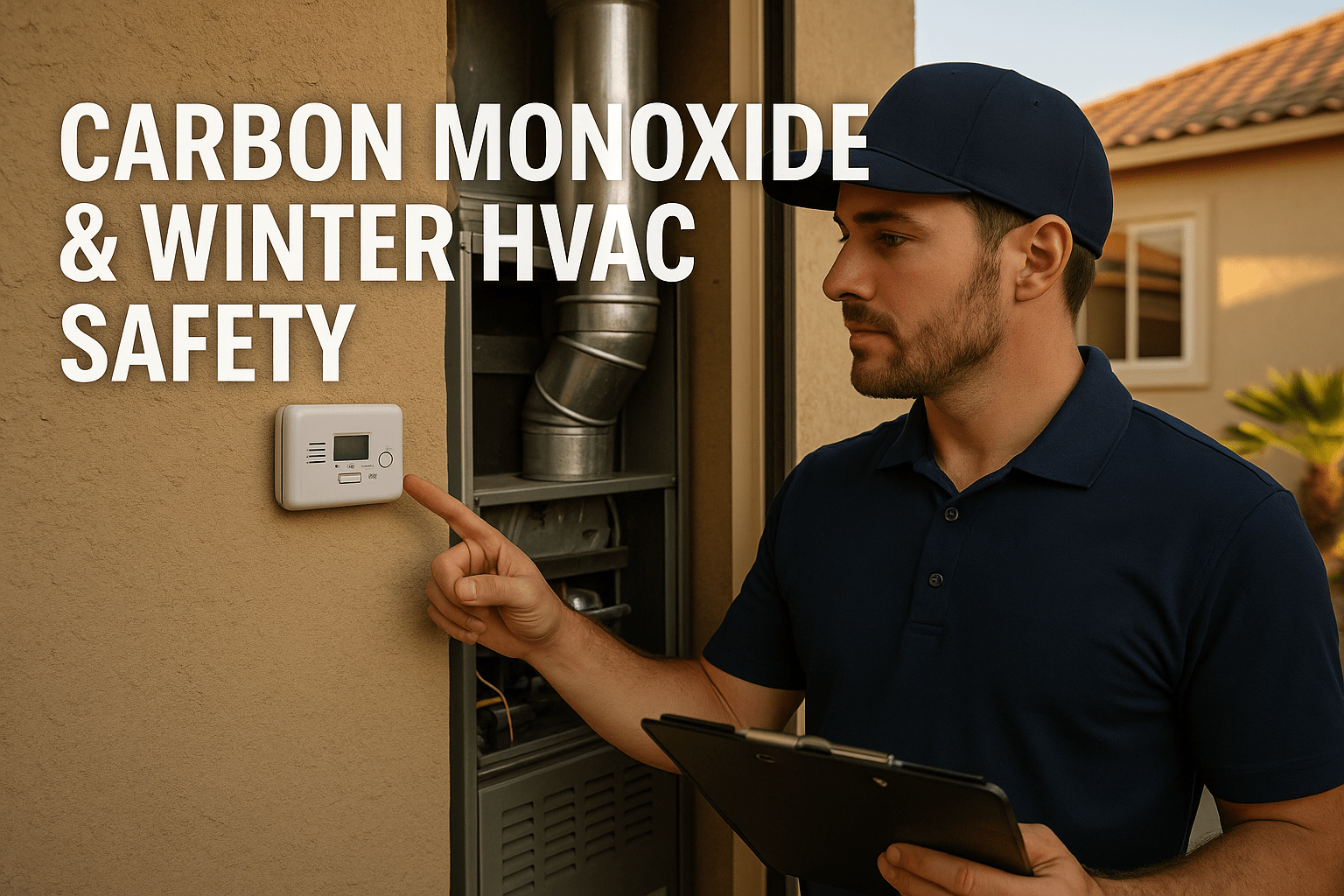
Why CO safety matters even in our mild desert winter
Las Vegas winters are usually comfortable – cool nights, mild days and the occasional cold snap. Because we close windows more in winter and run heating equipment more often, tiny problems with gas furnaces, water heaters, fireplaces or stoves can become bigger risks indoors. Carbon monoxide (CO) is created when fuel doesn’t burn completely. You can’t see or smell CO and that’s what makes it tricky: people often don’t realize there’s an issue until a detector alarms or someone feels unwell.
The good news is that keeping your home safe is straightforward: install CO detectors in the right places, follow a short, repeatable safety routine and have a professional look at fuel-burning appliances once a year. You’ll sleep better knowing you’ve covered the basics.
Quick perspective: Heat pumps (all-electric) don’t make CO themselves. If your home is fully electric, your winter risks are lower on this front. But most homes still have at least one fuel-burning appliance – often a gas water heater, a gas cooktop or a furnace – so detectors are still essential.
How CO detectors protect you (and where to put them so they actually help)
CO detectors are your early-warning system. They constantly sample the air and sound an alarm before levels are high enough to cause serious harm. Placement is what separates “owning detectors” from “being protected by detectors.”
Place them:
- Near every sleeping area so an alarm can wake you. If bedrooms are split across the house, place a detector near each sleeping zone.
- On every level of the home, including finished basements.
- According to the manual for height and location. Many modern sensors work well at typical outlet or eye level. Avoid tucking them behind curtains or near dusty, dead-air corners.
Care and replacement:
- Test monthly using the test button.
- Replace batteries on schedule (or at daylight-saving changes if that’s easiest to remember).
- Replace the detector when it reaches its end-of-life (often 5–10 years – check the unit’s label). Write the install date on the device with a marker so you don’t have to guess later.
If your layout is confusing or you’re not sure how many detectors you need, call a specialist. A quick walkthrough is inexpensive and guarantees coverage in the right spots.
Your 15-minute winter safety routine (repeat it every season)
You don’t need a toolbox. You only need your eyes, ears and a little attention.
- Step outside and look at vent terminations.
Find the outlets where your furnace and water heater exhaust outdoors. They should be unobstructed – no leaves, nests, lint or cobweb build-up. If a cold snap hits, check again after windy days. - Give appliances breathing room.
The areas around a furnace and water heater shouldn’t double as storage closets. Move boxes, paint cans and household items away so air can circulate and technicians can work safely. Crowding can lead to overheating and nuisance shutdowns. - Check the HVAC filter.
A clogged filter forces the system to struggle, which can trigger shutdowns and, in some failure modes, unsafe operation. Hold the filter to the light; if you can’t see light through it, replace it. Mark the next change on your phone calendar. - Test detectors and confirm you can hear them in bedrooms.
Press the test button. If an alarm is hard to hear with doors closed, consider moving it or adding another in the hallway. Replace batteries if the chirp indicates low power. - Do a quick “sniff and listen” pass.
You shouldn’t smell persistent combustion odors and the furnace shouldn’t repeatedly start and stop within a minute or two (short-cycling). Either sign is a reason to schedule a visit.
DIY vs. call a specialist:
DIY: clearing vents, making space around equipment, replacing filters, testing detectors.
Call a specialist: repeated shutdowns, unusual combustion smells, soot or scorch marks, any uncertainty about what you’re seeing or hearing.
Comments are closed